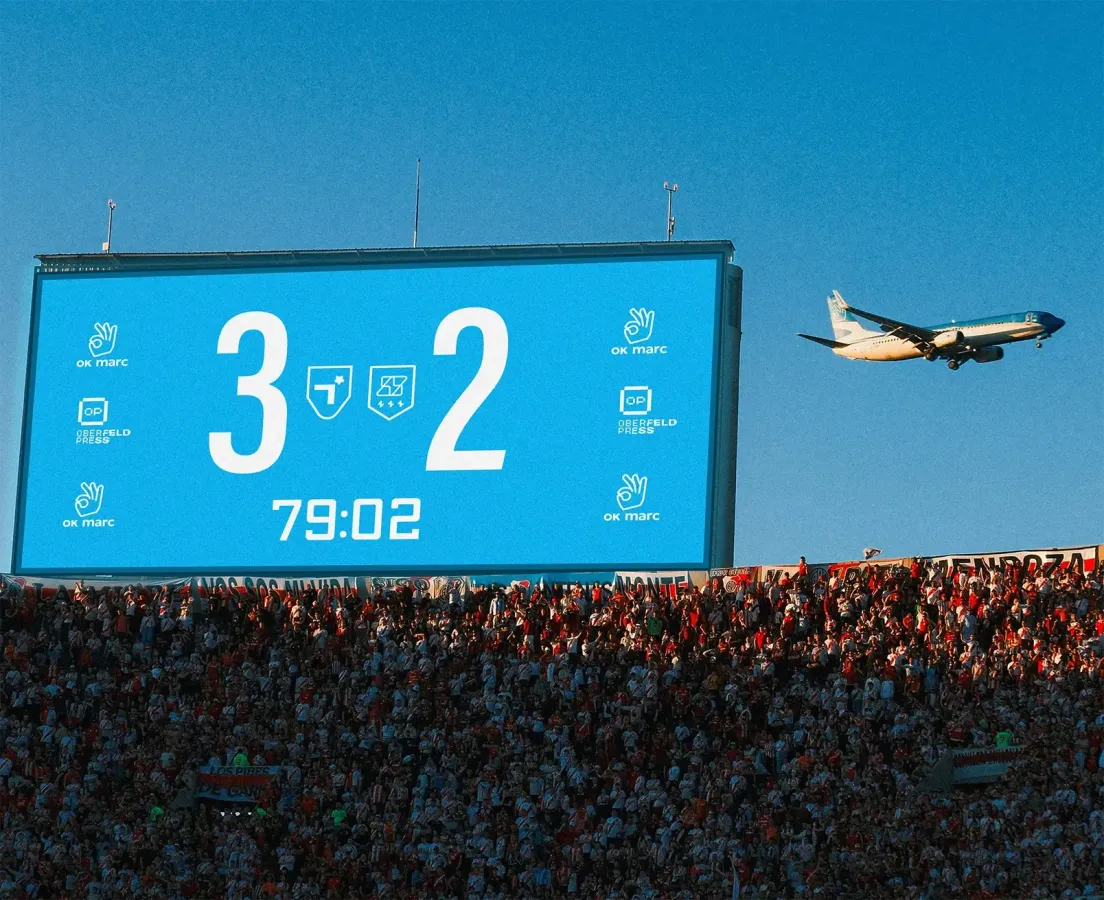

Most business leaders know something is off before they can say what it is. They've invested in the website. Updated the messaging. Maybe run a rebrand. The work is good. The team is experienced. And yet growth still takes more effort than it should. Prospects take longer to say yes. Referrals don't convert cleanly. The brand that worked at 20 people feels like it's straining at 80. The instinct is to blame the marketing, or the category, or the economy. But that's rarely it. The problem is a gap. Prism scores that gap.
What a brand infrastructure gap looks like
Every company operates at a stage, and this will evolve as the company does. A company with 3 employees has different brand considerations than a company with 30 or 300. Your company's specific stage is defined by revenue, team structure, operational complexity, and the sophistication of its client relationships. Each stage makes certain demands of the brand: it needs to signal the right level of authority, maintain consistency across a distributed team, support pricing at the right tier, and carry the weight of business development.
When your brand infrastructure is built for the stage you were at — not the stage you're operating at — the gap shows up as friction. Not in any one place. Everywhere.
This is not a rebranding problem. It's an alignment problem. And those require different interventions.
What Prism measures
Prism is a brand diagnostic built on the frameworks in The Brand Operating System. It measures the gap between where your company operates as a business and what your brand infrastructure can actually support.
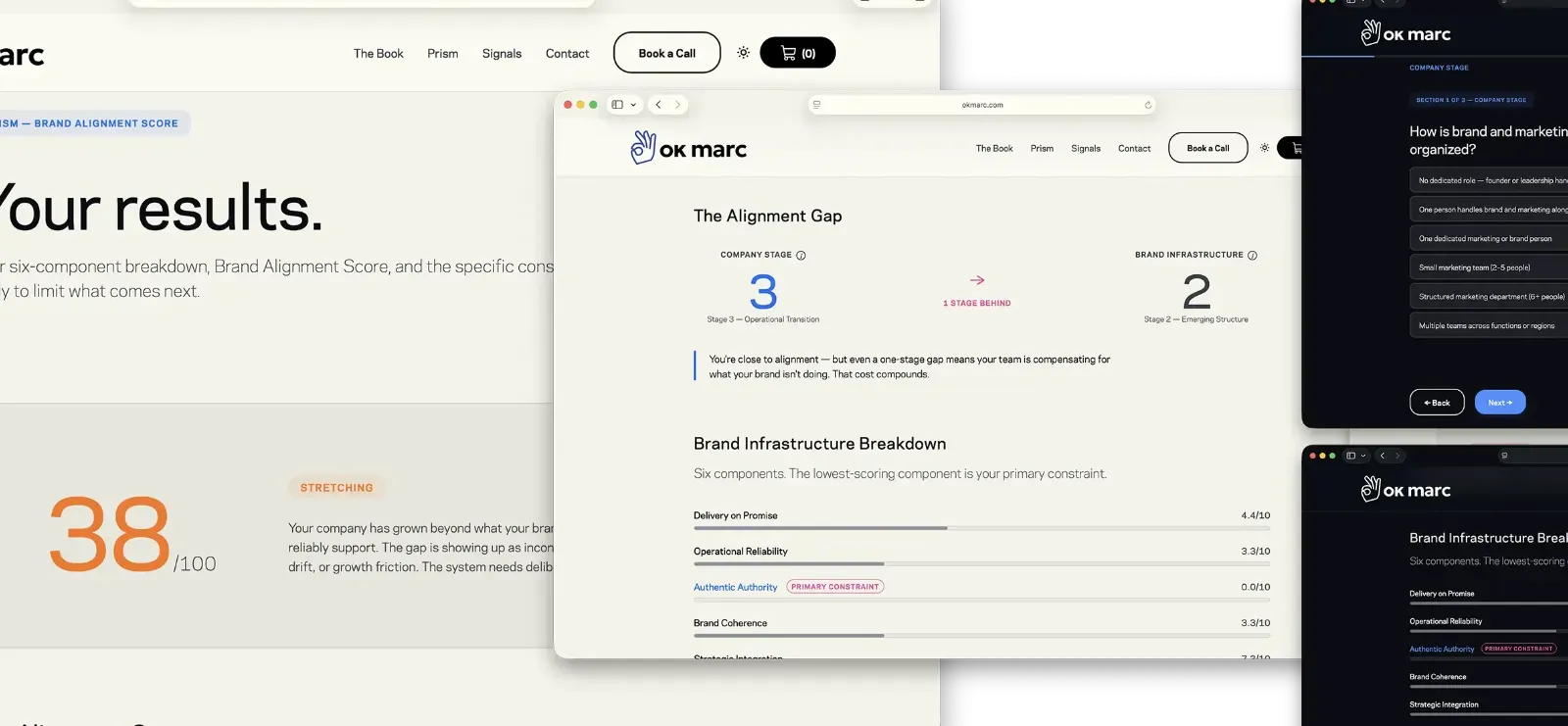
The assessment is 18 questions across three sections. The first four map your company to one of six growth stages — from founder-led to enterprise. The next 12 evaluate your brand infrastructure across six components:
- Delivery on Promise — The gap between what you say you do and what clients actually experience.
- Operational Reliability — How consistently your brand performs across touchpoints, teams, and time.
- Authentic Authority — Whether your positioning reflects genuine expertise or claims that outrun your evidence.
- Brand Coherence — How well your brand holds together as the organization grows and adds complexity.
- Strategic Integration — The degree to which brand is embedded in business decisions, not layered on top of them.
- Systems & Scalability — Whether your brand infrastructure is built to operate at the next stage.
The first five are the Trust Stack framework from The Brand Operating System. The sixth is the layer that determines whether the other five can hold under growth pressure.
The final two questions capture context — what you're trying to accomplish and where the pressure is showing up. They don't affect the score. They connect the diagnosis to what actually matters to you.
When your brand infrastructure is built for the stage you were at — not the stage you're operating at — the gap shows up as friction. Not in any one place. Everywhere.
What you get
Prism produces three outputs.
A Brand Alignment Score — a single number that measures how well your brand infrastructure matches the business it's supposed to support. Not a grade. A diagnostic reading.
A six-component breakdown showing where the infrastructure is functioning and where it's falling short.
A primary constraint — the specific component most likely to be creating drag right now.
The constraint designation is the most actionable part. Brand diagnostics are easy to overwhelm with findings. A "fix everything" output isn't a diagnosis — it's a list. Prism names the one component that, addressed first, improves the performance of the others. That's how the Trust Stack is designed to work.
Results are ungated. No email wall before you see what you've got. With that, you can send yourself, or your team, a copy of the results direct from the results screen.
Who should use Prism?
Prism is built for leaders at professional services firms, B2B technology companies, financial institutions, and growth-stage companies — organizations where credibility is the product and brand infrastructure either compounds or erodes the business case. The people who get the most from it tend to be CMOs, marketing directors, brand leads and designers who suspect the brand isn't keeping pace with the business, and founders or CEOs who feel the friction but haven't been able to locate it.
It's also worth doing as a team. When multiple people from the same organization take Prism independently and compare scores, the divergence between results is often as diagnostic as the results themselves. A founder who scores Brand Coherence at 8 while the head of marketing scores it at 3 isn't a data problem — it's the actual finding. Internal misalignment about where the brand stands is a constraint in its own right, and it rarely surfaces in any other kind of conversation. Take it yourself, then send it to two or three people closest to the business. The comparison will tell you something the individual score won't.
Who built this and why
Prism is built on the framework I developed across more than two decades working with professional services firms, B2B technology companies, and financial institutions. This is the same framework at the center of The Brand Operating System: The Architecture of Trust, Authority, and Growth, publishing July 15 2026.
I built Prism because the gap described above is the single most common finding in every engagement I take on. Companies at every stage are running a business that has outpaced the brand infrastructure supporting it. The gap is real, diagnosable, and fixable. But you can't close a gap you haven't measured.
Prism is the measurement.
Take the Prism Brand Diagnostic →
Free. 18 questions. Immediate results.
Does Your Brand Infrastructure Match Your Business Stage?
The Brand Operating System: The Architecture of Trust, Authority, and Growth published July 15, 2026, Oberfeld Press.
Post Main Image (Original): Ruben Mavarez, Unsplash.
Post Main Image (Modification): Marc Stress
Post Image inline: Prism detail screens.