The Brand Operating System
What is a Brand Operating System?
A Brand Operating System is a strategic framework that treats brand as foundational business infrastructure rather than a marketing line item.
Most companies approach brand the way they approach advertising: as a cost that requires ongoing spend to maintain visibility. The Brand Operating System reframes brand as architecture—a foundation that makes every other business investment more efficient, more durable, and more likely to compound over time.
The difference matters. Marketing tactics depreciate. Brand infrastructure appreciates.
The Performance Marketing Trap
Companies are caught in a familiar cycle: acquire customers, lose them, acquire more. The tactics get more demanding and more expensive. The margins get thinner. And there's a nagging sense that you're building on rented land.
Performance marketing emerged from a genuine insight—digital capabilities enable unprecedented measurement and optimization. But that measurability created an entire industry focused on extracting maximum return from every marketing dollar through continuous testing and refinement.
The problem isn't measurement itself. It's the tactical mindset that performance marketing encourages.
When businesses optimize primarily for immediate, measurable responses, they inevitably make decisions that undermine long-term strategic positioning:
- Platform Dependency: Growth depends on mastering algorithms controlled by others. Changes can devastate carefully optimized campaigns overnight.
- Tactical Exhaustion: What works this month may fail next month. You're trapped in endless optimization, racing to keep up with platform changes.
- Positioning Dilution: Messages that generate strong short-term engagement may undermine strategic differentiation.
- Competitive Commoditization: When everyone competes through performance optimization, businesses become increasingly similar. The winners are determined by who can spend more—not who creates more genuine value.
A Brand Operating System offers a fundamentally different approach: building competitive advantages that strengthen regardless of platform or algorithm changes.
The Core Components
How a Brand Operating System Works
A Brand Operating System isn't a single deliverable or a one-time project. It's an interconnected set of strategic components that work together to create compounding market advantage.
Brand Foundation The starting point is positioning clarity—understanding precisely what makes you different and valuable to specific customers. This clarity informs every business decision and enables consistent communication across all touchpoints. Without it, everything else is decoration.
Market Authority Authority isn't claimed—it's demonstrated. A Brand Operating System builds recognition through consistent visibility in the spaces where ideal customers seek information and solutions. This is thought leadership grounded in actual expertise, not content marketing for its own sake.
Brand Alignment Strategic positioning becomes competitive advantage only when it manifests consistently through customer experiences. Alignment ensures that what you promise matches what you deliver—across internal operations, external partnerships, and every customer touchpoint.
The Brand Trust Stack Trust doesn't just show up. It's built across five distinct components that work together:
- Delivery on Promise — Precise alignment between what you claim and what you consistently deliver
- Operational Reliability — Systems that ensure consistent experience regardless of who's involved
- Authentic Authority — Demonstrated expertise through transparent, value-driven communication
- Brand Coherence — Recognizable, unified brand expression across all channels
- Strategic Integration — Trust operating as a compound asset that supports premium positioning
Gaps in any component weaken overall credibility regardless of strength elsewhere. When all five function effectively, trust becomes a strategic asset that competitors cannot replicate through marketing tactics alone.
Strategic Communication Systems Maintaining brand coherence at scale requires systematic approaches—not sporadic inspiration. This includes insight development, message consistency frameworks, channel strategy, and engagement intelligence that tracks what's actually working.
The Brand Multiplier Growth decisions reveal how businesses really think about their brands. A Brand Operating System provides criteria for evaluating opportunities: which ones strengthen positioning, which ones dilute it, and which ones create genuine leverage versus temporary revenue.
What Changes
When the System Works
Companies with functioning brand systems don't scramble for every lead. They operate from a position of authority, attracting the right customers, partners, and talent instead of hunting for them.
The business impact is measurable:
- Premium pricing without price resistance. Customers pay more for providers they trust completely, viewing higher costs as reasonable given the reduced risk.
- Customer acquisition costs that decline as reputation compounds. Each satisfied customer becomes a credible advocate who generates additional opportunities.
- Market positioning that strengthens during competitive pressure. When economic conditions tighten, customers gravitate toward recognized authorities rather than taking risks on less established alternatives.
- Referrals that arrive presold. High-quality opportunities come from people who already view you as the obvious choice.
This is what it looks like to stop chasing and start compounding.
The Book
Go Deeper
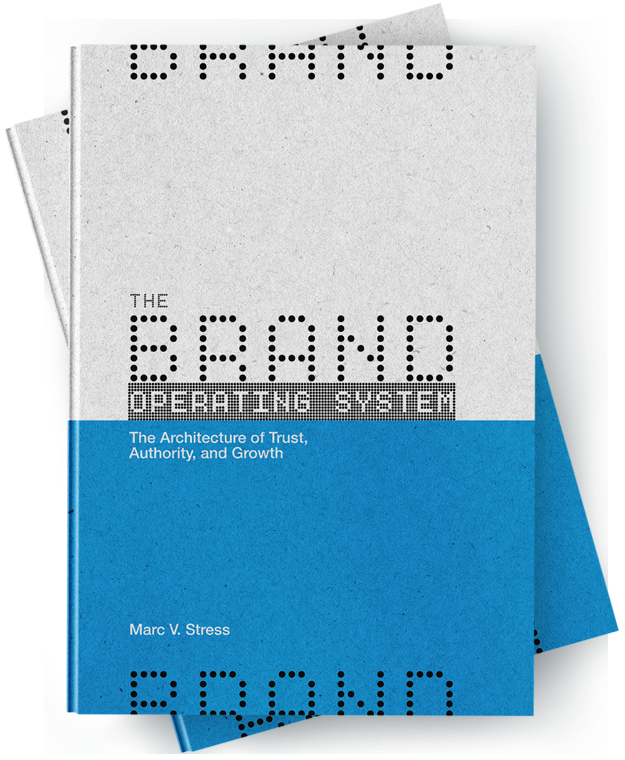
The Brand Operating System: The Architecture of Trust, Authority, and Growth is the complete framework—from diagnosing the performance marketing trap to building each component of the system to operating it as your business grows.
The Brand Operating System
The Architecture of Trust, Authority, and Growth
Marc V. Stress Summer 2026 · Oberfeld Press
Who This Is For
This framework is for:
- CMOs and brand leaders who sense that something structural is missing—who've invested in campaigns and deliverables but can't point to compounding returns.
- Designers and Marketers who are striving to level up their game, and have this nagging sense that there must be a better way to build something that scales, with less hamster-wheel.
- Founders who know their company is worth more than its current positioning suggests, but can't articulate why in a way that lands.
- The people who have to make the case for brand investment to boards, leadership teams, and skeptics—who need a better vocabulary than "awareness" and "engagement."
If you've recognized that performance marketing produces diminishing returns despite increasing investment. If you're frustrated by dependence on someone else's platform: Meta's algorithm or Google's ad auction or the Hubspot/Marketo treadmill. If you're tired of chasing whatever platform is demanding your attention this quarter, or whatever comes next — if you understand instinctively that genuine competitive advantage requires deeper thinking than tactical optimization — this is the alternative you've been looking for.
About the Author
Marc V. Stress has spent more than 25 years helping organizations embed brand into how they operate. He is Professor of Practice at Syracuse University's School of Design and serves as a Fractional Chief Brand Officer through OK Marc.
Speaking & Conversations
Marc is available for podcasts, panels, and keynotes exploring brand as infrastructure, the limits of performance marketing, and building systems that compound.
Get notified when the book is available.
Visit Oberfeld Press for pre-sale announcements, publication updates, and event information.